

About a 6-minute read
It’s hard to fathom a movie could contain the celluloid greatness of Clint Eastwood, Gene Hackman, and Morgan Freeman. But the feat was accomplished in 1992 with the release of Unforgiven, #68 on the American Film Institute’s 10-year update of their 100 greatest American films of all time (a mouthful if there ever was one). Westerns, as a genre, are not extinct, but they certainly are endangered. Modern releases are few, and the quality is inconsistent. Mentioning “Westerns”, however, is likely to kindle the names and faces of specific actors unlike any other genre. Clark Gable, John Wayne, and Kevin Costner are a few that flash through my mind, but perhaps no name goes more hand-in-hand with Westerns than Clint Eastwood. His icy, steel demeanor and snarl embody the persona of letting one’s actions speak louder than words. In Unforgiven, Eastwood directs and stars in the best picture winner that delivers an iconic pillar for the western genre.
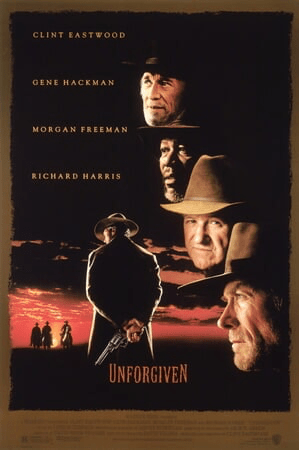
The first time I watched Unforgiven, maybe a decade or so ago, I did not particularly care for it. I expected something more violent for a film titled Unforgiven and that teased testosterone-fueled posturing that should precede numerous shootouts and other acts of carnage. While that expectation may be a damning assessment of my mental state, I don’t think it was unreasonable to expect a persistent level of intensity from a movie that looked like it should provide a persistent level of intensity. As I watched, however, I believed Unforgiven didn’t know what its tone should be. The film lays a foundation of seriousness from the beginning, then it layers on light comedy, and finally, there is a finishing sprinkle of quirkiness in character and situation. Films don’t have to be one thing, but Unforgiven’s construction made it difficult to settle in and connect with the plot and characters.

Watching again—perhaps because I am a more mature viewer, or perhaps because I tempered my expectations of the film—I realized Unforgiven was not supposed to be a typical Western. It has layers because the plot is not the film’s purpose but rather a vehicle for bringing together characters whose pasts affect their present. They actually live in the world rather than merely pass through it. The characters’ interactions draw out their true colors and paint shades of who they were before they enter the film’s timeline. And while the plot is not Unforgiven’s focal point, this is where it becomes important.
In the vast openness of the unsettled western United States, it’s no surprise that most folks operate with a degree of anonymity beyond the small sphere where they live. Conversely, it’s miraculous that two people can reconnect in an unconnected world. Unforgiven shows both sides where either reputation or run-in can make a person widely known (often infamously), and then where there is a larger population that may pass from the world being known only to a few. The West’s mythos was built on legendary characters, whose actions inflated with each retelling. This created larger-than-life personalities and bravado that led to many foolhardy actions and early graves.
So that’s the world of Unforgiven, but what about the movie itself? Unforgiven has several qualities that make it a standout entry in cinematic history. First, the cast is laden with silver screen icons. Clint Eastwood, of course, feels right at home in a Western. Here, he’s a grizzled widower with two young kids. It’s hard to reconcile his character’s (William Munny) age with Eastwood’s looks, which is admittedly distracting, but a key point of the film is that Munny is a reformed outlaw past his prime, which Eastwood nails. Then, there is pre-Shawshank Morgan Freeman, who does not get enough screen time as Ned Logan but plays a perfect companion to Eastwood. They are two men who set out on serious business but interact in an unserious way as they struggle to overcome the degenerative effects of aging on their once finely honed skills. On a separate path bound to intersect with that of Munny and Logan is Gene Hackman’s Little Bill, who is a fiercely confident lawman of repute. Little Bill believes he always has the upper hand even when the odds say decidedly otherwise. It’s a persona he must maintain, and often support through action, to sustain his power and authority in the town of Big Whiskey, Wyoming. There is a sequence with a character named English Bob, played by Richard Harris (the original, and better, Dumbledore) that effectively portrays Little Bill’s qualities based on how he wields his power over others. Beyond the main trio of Eastwood, Freeman, and Hackman, other notable cast members include the aforementioned Harris, Saul Rubinek (any Warehouse 13 fans?), and Frances Fisher, who always seems to play a matriarchal figure, even if she is a prostitute here.
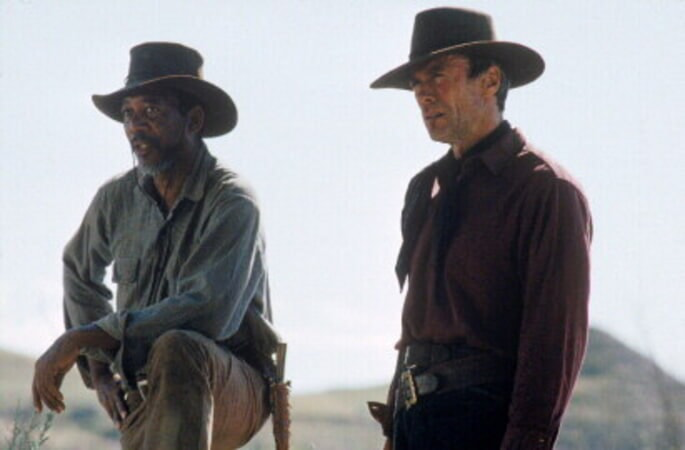
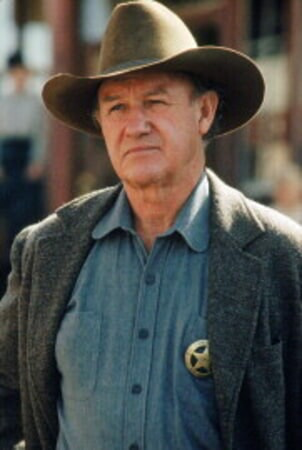
Beyond the acting, the world of Unforgiven is visually lush. Westerns lend themselves to stunning natural imagery that captures the wide-open spaces of a yet undeveloped world, where sunrises and sunsets fill the canvas with colorful hues and the changing seasons and weather add diverse textures. Unforgiven captures these picturesque moments with great effect, so it’s equally disappointing that much of the movie occurs in the dark of night. My biggest nit to pick is that it’s impossible to clearly see the actors’ expressions and actions for large portions of the film. This was the case on a 4K Dolby Vision version, so I can’t imagine how it looked on film in 1992 or VHS. What’s the point of beautifully crafted physical sets and a screen-stealing cast if they’re hidden in shadow? The nighttime action is important, and I can understand the desire for a natural look and feel (i.e., lit by candlelight, flame, or lantern), but this was an issue to an almost detrimental degree. For every part in Unforgiven that is visually arresting, there are equal parts that are distractingly dark.
Unforgiven is a finely crafted character-focused Western. I’m still not sure this would be a love-at-first-sight flick, but I had greater appreciation on the second watch for the layered movie it appears to be. Ultimately, the cast carries a thin plot and inconsistent visuals. But, Unforgiven holds its place as a keystone Western, even if there was an opportunity to do, and be, more. Also, I believe the character of John Wick is based on Clint Eastwood’s clipped, impactful line delivery (which does not impact my perception of Unforgiven, just something I found amusing). Unmistakably, this is a great American film, but from what I’ve seen on AFI’s list so far, there are better films for #68. However, because Unforgiven is a Western and embraces the mystique and legend of the period, it has enough unique qualities to give it great worth in the cinematic pantheon of noteworthy films.
 HobbyScope