
About a 7-minute read
Have you ever watched a movie or show, or maybe been in person, where a character says something or acts in such a way that you cringe with second-hand embarrassment and want nothing more than to escape that moment and feeling? I know The Office provided at least one of those experiences every episode. I can also think of various group conversations where someone may have said something inappropriate or naive that left the rest of the group scrambling to change the subject. I have definitely rammed my foot in my mouth on numerous occasions where I was either trying to be funny or thought I was too cool to misstepe into a faux pas. To be clear, I have never been “too cool”, and while I have the occasional comedic banger, it is usually balanced by an embarrassing flatline after attempting to exploit the success. The embarrassment, however, sits solely with me, and the intent has never been to make others uncomfortable. Additionally, I am never going to air dirty laundry in front of people I just met. In Who’s Afraid of Virginia Woolf?, number 67 on AFI’s 100 Greatest American Films of All Time, the film progresses via the diatribes and contentious monologues of its four main characters. The action is chaotic, quippy, and claustrophobic; earmarks of a work that moved from stage to screen. I wanted to hate some characters and like others, but the film moved them through cycles of awfulness to redemption to pity. In the end, like nearly all the movies on AFI’s list, I liked Who’s Afraid of Virginia Woolf? even if I did not fully understand all the shifts and subtleties of the film’s dialogue.
The film’s origin is a play of the same name written by Edward Albee, with the title a play on the song “Who’s afraid of the big bad wolf…” from Disney’s Three Little Pigs. Virginia Woolf has no physical connection to the play or film, as far as I could tell. She apparently was, however, a pioneer in the use of stream-of-consciousness narration, which is prolifically used in Who’s Afraid of Virginia Woolf?. As a former English student, I feel I should have more awareness and understanding of such influences and literary juggernauts of the past, but that was something about this movie that makes it stand out from others: I learned quite a bit about the film’s genesis and its cast. All that said, the stream of consciousness allowed for more intimate connection with the characters but created a struggle in comprehension, and I had to turn to the internet for some interpretive assistance. In true form for higher-brow literary works, Who’s Afraid of Virginia Woolf? is an allegory for 1960’s America where success and confidence are prevalent outward-facing characteristics for Americans, but concern and consternation grows behind closed doors. The pristine sheen seen by the world is merely a facade, and it appears many Americans, like the primary couple in the film, chose to live with the festering, potentially explosive outcomes. In the movie, this national attitude manifests as a couple who unleashes humiliating verbal attacks toward one another in the presence of a purer couple who is yet seemingly unweathered by years of disdain and lying. True to the theme, however, that purity is still just part of the facade. With every line carrying ambivalent meaning, how the characters interact to uncover the bedrock layer of truth about one another is what drives the film’s quality.
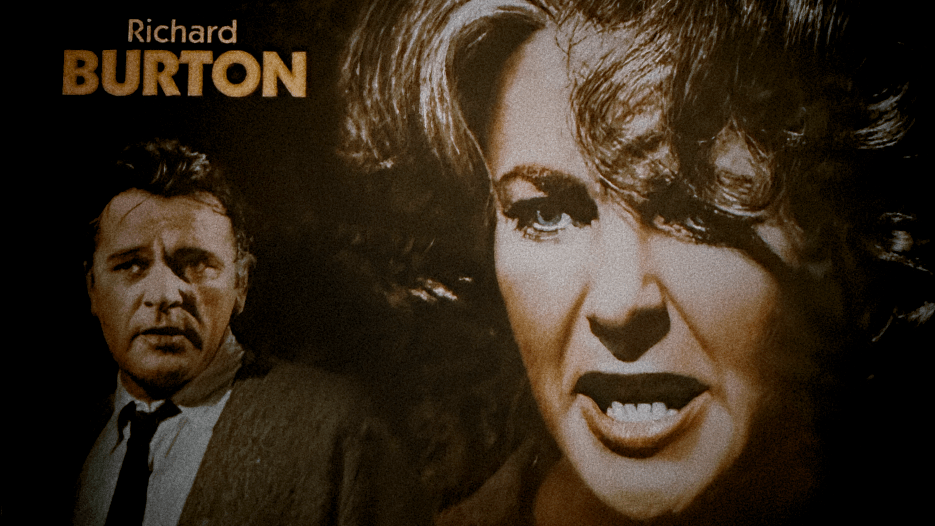
I said I learned quite a bit from Who’s Afraid of Virginia Woolf?. The cast is comprised of renowned Hollywood names, with fascinating backgrounds of interestingly lived lives. I never experienced Elizabeth Taylor or Richard Burton in their primes. Who’s Afraid of Virginia Woolf? is my first exposure to Elizabeth Taylor outside of old commercials along with never having seen anything starring Burton. That may sound sacrilegious given their prominence in Old Hollywood, but that is why I am going through this list; there is plenty of catching up to do. As for the stars, Taylor and Burton are as fascinating off-screen as they are powerful on. Twice married to one another, you cannot watch this movie without wondering if the lines blurred between the script and their shared experiences. There is the foundation of love and the respect that exists between human beings with intimate knowledge of one another that somehow perseveres amidst the mountains of vitriol being slung. Every line cuts, but there is an underlying magnetism pulling on the characters’ love to hopefully bring them together to coalesce in one another’s arms.
Caught in the fire are Nick and Honey, a contrasting younger couple to Martha (Taylor) and George (Burton) with the twinkle of young love in their marriage and optimism for a successful future. Nick is played by an startlingly young George Segal, who I most recently watched as the grandfather in The Goldbergs, and Sandy Dennis, whose talent shines in this film but avoids anything else I may have seen. Despite Nick and Honey’s puppy dog eyes for one another, Martha and George pull them into their vortex of deceit to uncover secrets that reveal the fragility of Nick and Honey’s marriage as well as any potential weakness of character. It is appalling and yet engrossingly entertaining to see the evening descend into the unraveling of the life one thinks they established for themself.
After learning more about the cast, their acting pedigrees, and personal adventures, my surprises continued with the director, Mike Nichols. Who’s Afraid of Virginia Woolf? is Nichols’ first directing credit, so he came out swinging. The rest of his filmography is just as impressive, with his follow-up non-other than The Graduate and other notable credits such as The Birdcage, Regarding Henry, and Charlie Wilson’s War. There are other recognizable and notable works of his direction, but those are not even the most interesting aspects of his life. He was married to Diane Sawyer until his death in 2014, which very much feels like a random pairing. Most fascinating, however, is the fact he fled Nazi Germany in 1939. Sometimes, the journeys taken by the successful or famous on their way to noteworthiness is a greater story than anything that comes while at life’s zenith.
Now, for the film itself, how is it? Coming from stage to screen, there is a noticeable rigidity to the blocking and dialog, where the movements feel more timed than natural and the dialog very audience-focused (opposed to building rapport with other characters). None of this, however, detracts from the movie’s quality; it is not something I would likely even note if I was ignorant of the content’s origins. Conversely positive, enriching the film is a grittiness of a lived-in home and characters able to carve their own spaces and personalities. It all blends nicely allowing the viewer to try absorb what is occurring on screen and marvel at the chaos living behind closed doors. Critically, Who’s Afraid of Virginia Woolf? won five Academy Awards for Best Actress in a Leading Role (Taylor), Best Actress in a Supporting Role (Dennis), Best Cinematography – Black-and-White (Haskell Wexler), Best Art Direction-Set Decoration – Black-and-White (Richard Sylbert and George James Hopkins), and Best Costume Design – Black-and-White (Irene Sharaff). These wins and other nominations reflect a film with a certain style and intimacy that you may not expect. Additionally, the subject matter and performances are potent, which, when part of the whole package, create an entertaining and engaging piece of cinema.
This was another surprising one for me. I did not know what to expect from this film, and admittedly, I assumed Elizabeth Taylor played Virginia Woolf. Yes, I thought it was some biographical or satirical piece about the writer. Coming out on the other side, however, this film showcases how strong character performances can carry a movie and be just as entertaining as something with more action, spectacle, or twists. This was simply watching relationships erode down to the studs of their native attraction and then wondering how the couples will survive the awkwardness of the next morning after a night of mental debauchery laid bare by the revealing clarity of the dawning sun. It is reflective of human interaction when social decorum breaks down and introspective of how we navigate our lives with little lies injected here and there to make facing the next day a digestible proposition. Huzzah, cinema.
 HobbyScope