
About a 4-minute read
Sometimes, what makes a movie legendary is the simple fact that it was made at all. Sometimes, there are those experiences that put the cast and crew through hell for the art. And sometimes, the stories behind the scenes are better than what ends up on screen. Number sixty-five on the American Film Institute’s 100 Greatest American Films of All Time (10th Anniversary Edition), The African Queen, is one such movie. The Hollywood heavies, on screen and off, came together and persevered to create a 1951 epic that eschewed the easy and stood in defiance of the communist witch hunt casting a shadow over the industry.
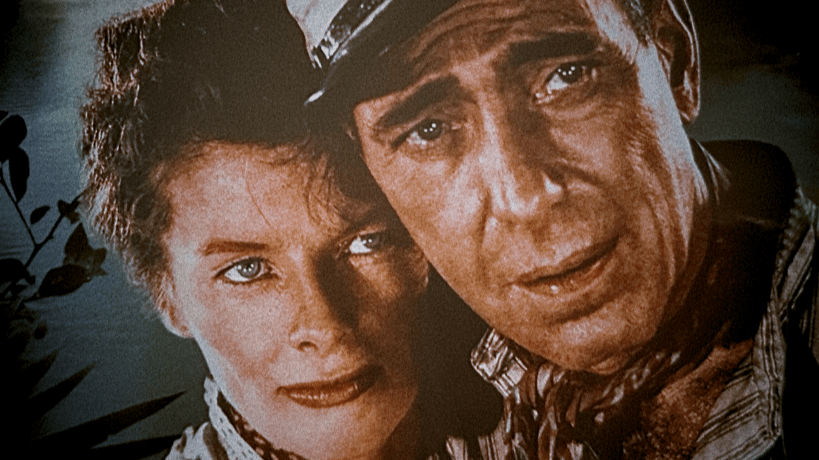
Adapted from the 1935 novel by C. S. Forester, The African Queen follows the voyage of Charlie Allnutt (Humphrey Bogart) and Rose “Rosie” Sayer (Katharine Hepburn) as they navigate the small steamer, The African Queen, down the treacherous Ulanga River in Africa to Lake Albert, with the intent of turning The African Queen into a torpedo boat to destroy a German gunboat patrolling the lake. This comes after the outbreak of WWI and the death of Rosie’s brother at the hands of German soldiers. Directed by John Huston, the film mixes romantic, adventure, and comedic elements to craft an epic cinematic cocktail representing the best the era had to offer. The writing from this period can come across surprisingly blunt, as if it is forcing the actors’ emotions rather than allowing them to establish nuances and range for the characters, and The African Queen suffers a few scuffs in this regard. While Bogart and Hepburn exchange fluidly brisk dialog or capture the screen during a personal rant, there are moments, particularly when their feelings for one another become realized, that their physical interactions and accompanying dialog are startlingly awkward, and the actors’ chemistry momentarily disappears. I spent too much time trying to decide if this was intentional or truly a poor moment of acting. If intentional, the writing fails to successfully bridge the moments on either side of the blunders. With everything the film brings to the table, however, the dialogic hiccups can be forgiven.
It is important to view The African Queen as the whole package, especially in 2026. Today, some of the effects and sound create disconnects from the immersion one would typically have while watching a movie. For example, when The African Queen hits treacherous stretches of the river, there are sequences with Bogart and Hepburn on a soundstage set against a blue screen backdrop spliced with a scale model being tossed around in the “river”. In another scene, Bogart is replicating the movements and sounds of hippos and chimpanzees, and his sounds do not appear to come from his person. Watching the film in 1951, these moments are perfect for stitching a viewer’s imagination together with how the characters interact with their environment. I would think nothing of seeing a model on the screen or hearing an unnatural sound, because that is how the filmmakers are further immersing me in the story and action. Heck, there are movies made in my lifetime utilizing those same filmmaking “tricks”., and for this film in particular, a little grittiness is understandable.
The African Queen was mostly filmed on location in Africa in poor conditions that saw nearly the entire cast and crew get sick with malaria, dysentery, or other maladies that the continent unleashed. On top of that, crew quarters, dressing spaces, and equipment all had to be rafted down the river as if they were an extension of The African Queen. And then on top of that, even the in-studio filming was done in the United Kingdom to keep Bogart, Hepburn, and Huston out of the crosshairs of the House Un-American Activities Commission that was targeting Hollywood personalities during this period. It took a tremendous amount of ingenuity and nerve to stick with the production and see it through. Knowing that, the few rough edges the film wears as badges of prestige only add to its mystique.
While there is plenty to criticize in a 75-year-old movie, it all pales in comparison to the film’s accomplishments in bringing this tale to life in such a visceral fashion. The primary setting is a small boat. The antagonist is the Ulanga River. There are only two people on screen for most of the movie. And with just that, you are watching palpable emotion between the characters, and you always sense the river’s presence and how the characters’ fortunes can change on a whim or wild current. The African Queen is a film built to persevere on the shoulders of Hollywood legends. It is an exotic adventure with tints of revenge and patriotism. That is why it sits at 65 as an all-timer.
 HobbyScope