
About a 5-minute read
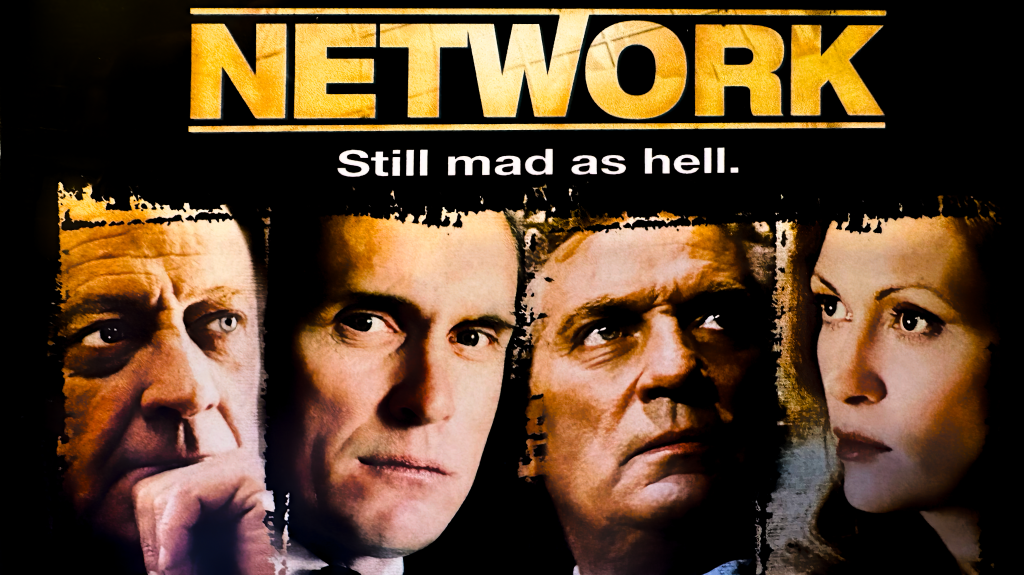
Here’s a movie I didn’t expect to go off the rails: Network. Number 64 on the American Film Institute’s 100 Greatest American Films of All Time, this 1976 Sidney Lumet film looked like a peek behind the curtain of television in the Seventies, where, in this reality-adjacent setting, four major networks navigate market share, programming popularity, and corporate dealings. Network focuses on the fictional UBS and its key players, highlighting the stress and relationships of convenience at play when trying to climb to the top or simply stay relevant. This movie caught me by surprise – while it is rooted in the real world and concerns of its decade, the characters share a surprising ignorance to consequences outside their own ambitions and desires, which ultimately leads to a jaw-dropping ending that hastily cues the credits instead of providing the comfort of an amenable conclusion. The cumulative experience left me with some kind of in-between feeling. Despite not giving me an immediate “rah-rah” reaction, Network has redeeming qualities that allow the film to stand out and etch a spot on AFI’s list.
I was not alive in the Seventies, but I’ve sat through enough social studies and history classes to understand the general sentiment of the decade with the abounding concerns for the economy, government mistrust, and foreign relations. Network takes a snapshot of this civil angst and gives it character and presence in the film. Through interactions with the Communist Party of the United States, the fictional Ecumenical Liberation Army, and the development of the Howard Beale Show, UBS serves its viewers a mixture of curated domestic violence and proselytizing. This programming delivers major ratings for UBS and, in turn, much-needed revenue. The Howard Beale Show, emceed by the show’s namesake played by Peter Finch, a former nightly news anchor suffering from a mental crack that has him believing he receives divine guidance for the future of mankind, provides the biggest ratings boon and buoys the career of the show’s creator and programming director Diana Christensen (Faye Dunaway). This arc of UBS’ rejuvenation carries forward the concepts of corporate greed and indifference while emphasizing the absence of conscience and limits when it comes to self-preservation and promotion. While an assessment of that period’s landscape, the commentary remains accurate in the 2020s and every decade in between.
Network has great characters solidified by outstanding performances that leave you stunned that they could be delivered with such deadpan seriousness. I’ve already mentioned Dunaway and Finch, providing beguiling performances in their roles, and Network also boasts other standout characters brought to life by William Holden, Robert Duvall, and too briefly by Ned Beatty. I can’t think of a single performance that fell flat or felt out of place. There were numerous times I had to pause and rewind because I could not believe what a character said, that they were serious, and their words’ ultimate consequences. This is especially true at the end when a group crosses a point of no return, and after the resulting action plays out, you sit there stunned asking, “In what world?!” Surprise, you beautiful naive bumpkin (speaking to myself), the answer is, “Our world.” It’s actually wild how relatable the characters can be before veering toward a headfirst dive into insanity.
This insanity has its genesis in the self-serving decision-making of all the key characters. Dunaway’s Christensen is the director of programming at UBS, and she is willing to orchestrate shady dealings to create programs that prey upon the ubiquity of violence and viewers’ inherent distrust of their neighbors and government. Robert Duvall is Frank Hackett, who is essentially an underboss for UBS’ controlling corporation, answering directly to the mysterious “Mr. Jensen”, played by Beatty. Hackett foresees recognition and riches in his future when he takes credit for bringing UBS out of the red. Howard Beale (Finch) refuses to accept a forced retirement and uses whatever on-screen time he has left to rant and rave and threaten to commit on-air suicide, which ultimately allows him to ascend in popularity but be taken advantage of by Hackett and Christensen. Beale’s biggest contribution is an broadcast diatribe that gets the viewing population to literally stand up and shout, “I’m mad as hell, and I’m not going to take it anymore!” It opens the door for his life after the news desk but also sends him down a fateful path. Then, there’s Max Schumacher (Holden), who runs the news division of UBS and persists as a supportive friend and colleague of Beale. While Schumacher maneuvers to protect Beale and UBS News from corporate takeover and influence, he, like so many others, ends up pursuing his own pleasures. His stifled moral compass destroys his position and marriage and creates a toxic relationship that he treats like an addiction. The characters feign complexity and are each deplorable.
The one character, however, who maximized their screen time is Ned Beatty’s Arthur Jensen, who runs the corporation in charge of UBS. In a single, beautifully shot scene, Jensen berates Beale for interfering in the politics and economics of the world with a powerful speech that confirms Jensen’s god-like status and influence. It is easily the best scene in the movie and one that fully captures the viewers’ attention.
Network rolls along as seemingly any other drama before ending in chaos. The journey is strange but insightful in being able to look back at the period and see behind the curtain of major network television, at least as it’s portrayed in 1976. I found much of the film to be more distracting than entertaining, but there were still moments that left me with no choice but to take notice. A sneaky line of dialogue here and there had to be caught or I would risk missing important plot turns. These phrases were deftly delivered by an excellent cast giving taught performances. Overall, Network is a fine film. While the complete package was not my favorite, there is plenty of worth in renewing for another season to keep it at number 64.
 HobbyScope