
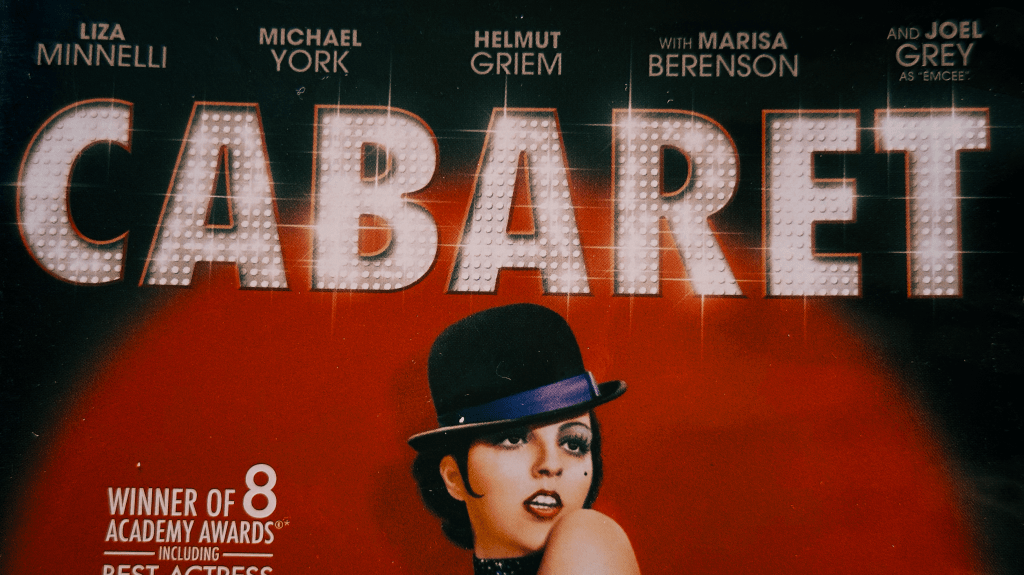
I never considered Cabaret to be my jam, or my jelly. I came to that conclusion through pure assumption, having never seen the film nor really looking into what it is about. Hearing the name Cabaret and seeing the cover art conjured images of Moulin Rouge!, which is a fine movie but not cracking any of my top lists. I enjoy going to off-Broadway shows and get caught up in the musical numbers. Watching them on screen is a different story. I also never considered I could enjoy a Liza Minnelli film. Nearly all references to her in my lifetime have been in jest, poking at an actress with an insatiable zest for performing that is past her prime. So, I found myself with a complete misconception of what Cabaret is and the film’s subject matter. Its presence at number 63 on AFI’s Top 100 American Films forced me to reconsider my perception of the film and give it a chance.
At Cabaret’s heart is a story navigating love and ambitions. The personal journeys of the characters occur against the backdrop of 1930’s Berlin and the spread of fascism. The film introduces Michael York’s Brian, a Brit coming to live in Germany to teach English as part of his doctoral program from Cambridge. I have to say, having really only known York as Basil from the Austin Powers trilogy, it was refreshing to see his true artistry on display here, portraying Brian with subtle degrees of naïveté, desire, and growing disillusionment. Brian quickly meets Liza Minnelli’s Sally Bowles, who is a performer at the Kit Kat Klub, the namesake cabaret. Sally is a big dreamer who wants to enjoy life and has no qualms about sharing exaggerated truths to lift her ego and standing in others’ eyes. Their relationship spans from platonic to intimate and delivers a plethora of emotional angst. Together, they engage with electric characters who ultimately add complexity to Brian and Sally’s lives.
The vehicles by which Cabaret progresses through time span the garish and subtle. Scenes from the Kit Kat Klub are chaotic, like from a fever dream and akin to the surreal feeling of a film like A Clockwork Orange. This is where the musical numbers occur. I initially dismissed them as oddities and filler, which left me slow to recognize the numbers conveyed the next big issue to be tackled by the characters in addition to updating the current state of German politics. As the film progresses, the performances assume darker tones to reflect the Nazi fervor increasingly taking hold in the populous. Complementing the cabaret’s overtness, there are scenes interjected, almost with a sense of randomness, showing more Nazi presence and the resulting brutality against those targeted by Nazi propaganda or standing against it. Knowing many of the characters, including most of the supporting roster, are either Jewish or live provocative lifestyles adds a growing darkness and foreboding to Cabaret as it progresses. We know how that story goes and ends.
Despite the ominous undertones, Cabaret is beautifully crafted and acted. Each shot is engaging and expertly conveys a feeling of isolation or freedom depending on what is required at the time. When the focus needs to be on an actor’s emotion, they are framed to steal your attention without losing sense of the scene’s breadth. When the focus is action, the viewer is provided with shots that take it all in while allowing the inherent energy and chaos to reach off the screen and envelop the viewer. I have already talked about York’s performance, but the main star is Minnelli. She is a performer in the truest sense, with a skillset that carries the stage sequences and plays your emotions with Bowles’ inherent sadness. Minnelli’s big doe eyes help with this as well. Brian and Sally’s relationship is one of mutual benefit and toxicity but with inherent care for one another. It is so uneven, deceitful, and loving that it is impossible to look away.
Cabaret has far more emotion and substance than expected. Ultimately, the film was darker and of higher quality than I could have guessed. The old adage is to never judge a book by its cover, and yet I fell for the trap. There are layers to the film’s story that keep the viewer on edge and intrigued as to how the characters will navigate the growing challenges that ultimately lead to hell in Europe. While that intrigue is destined for an unsatisfying end, Cabaret is a dynamic piece of cinema that fits perfectly at 63 on AFI’s list.

