
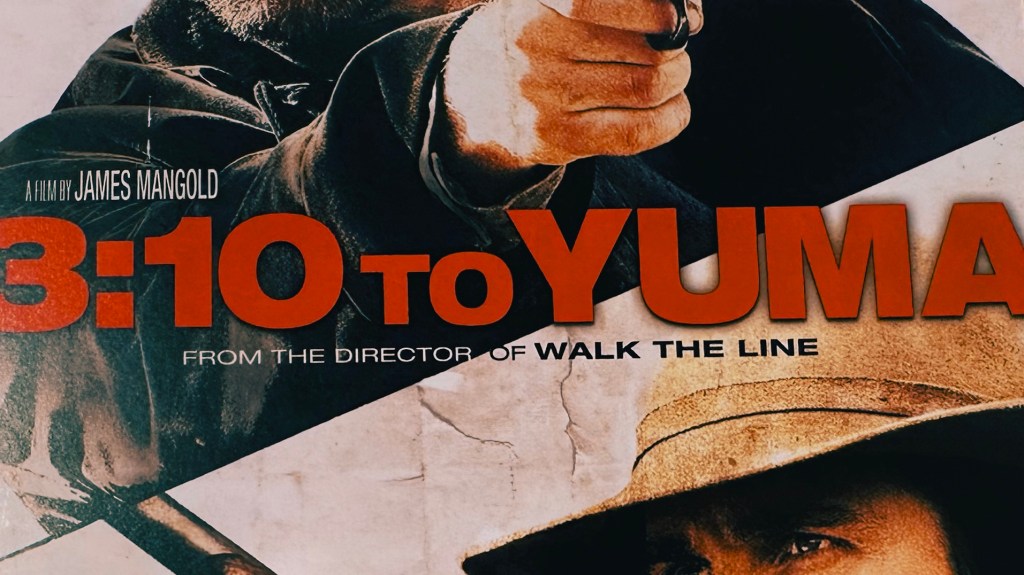
I have had opportunity to write about multiple westerns, and I am sure I have said before that they are now make up a rare genre. While modern films may be built with a similar structure and contain similar character archetypes, filmmakers and studios simply are not creating works set in America’s Wild West. Frankly, it is a shame. The genre provides a bright canvas for imaginative, colorful storytelling that, despite decades of the western being ubiquitous across film and screen, feels like there is untapped potential, especially with the emergence of uninitiated audiences. So, when a quality modern western is available, it is worth taking the time to appreciate it. 2007’s 3:10 to Yuma is not an original work, being a remake of the 1957 film of the same name, but its direction, cast, and overall vibrancy make it worthy to stand and be judged on its own merits.
Now, I must shamefully admit I have not seen the original 3:10, so I can only comment on the 2007 version, which is fine, because I needed to revisit my feelings toward this film. When I first watched 3:10 to Yuma all those years ago, I did not particularly like it. At that time, westerns did not really appeal to me, and seeing the movie starred Russell Crowe and Christian Bale lured me into expecting more of a spectacle. Instead, I got Crowe taking a heel-turn in what is essentially a dusty, condensed version of the one ring’s journey across Middle Earth to Mordor. Bale, the protagonist, is even hobbled by only having one full leg – he is, ahem, hobbited. There were clear good guys and bad guys, but then the characters behaved in unexpected ways. And while there was the typical Wild West violence one would expect, even amplified to match the era, I felt like there should have been more. So, I labeled and buried the movie as an unexpectedly confusing watch. Still, I felt I had to have missed something, so while I did not necessarily enjoy my initial viewing, I vowed to one day hop back aboard the 3:10 to Yuma.
I am not sure exactly what triggered my recent rewatch, but I can identify several contributing factors. First, when watching Yellowstone or, more recently, Dutton Ranch, the actual ranching segments mesmerize me. There is something about the horsemanship and cowboy lifestyle that transfixes my imagination, even if I have no designs on such a life myself. Second, I have been on a Kevin Costner binge lately, and even though I have not recently watched any of his westerns, Costner will forever be associated with the untamed frontier from Dances with Wolves. Third, my father-in-law watches a lot of old programming when he visits, so there often seems to be an episode of Gunsmoke on in the background. Catching an episode here or there helped me see shows from that era were better than I typically gave them credit for. Fourth, I am building a Plex digital movie library out of my physical movie collection, and 3:10 to Yuma happens to be one of the converted titles, so I am always scrolling by it in the alphabetically sorted (numeral first) list. With all the build-up of other western influences, this time, I did not scroll past.
Okay, I have droned on like the introduction to an internet recipe. What about the movie itself? Directed by James Mangold and starring Russell Crowe, Christian Bale, and Ben Foster, 3:10 to Yuma focuses on the intersection of two men’s lives, outlaw Ben Wade (Crowe) and rancher Dan Evans (Bale). Wade has been a thorn in the side of the expanding Southern Pacific Railroad, and when he is finally captured, a posse is constructed to escort him to the train that will take him to Yuma, Arizona to stand trial for his crimes. Evans, in desperate need of money to keep his ranch and family afloat, joins the posse, and the story progresses, while situation unravels, from there.
All the classic western components are here. You have a larger-than-life villain whose reputation does more work for Wade than he does himself. Then, there’s the grizzled hero with a complicated past and unshakeable morals. There are small-town set pieces to break up long stretches of wilderness with action occurring throughout. Then, along the journey, impactful characters come and go against of tapestry of heartbreak and impossible choices. 3:10 is beautiful to watch with all its color and grit amidst a hard world.
Nothing works, however, if the acting is not on point, which it is here. Crowe is superb as Wade, with unspoken confidence and a practiced ferocity that perpetuates Wade’s infamy. Despite being named as the obvious bad guy, Wade has to keep stating throughout the film that he is, in fact, a bad guy, but his actions and demeanor show he is caught between maintaining this persona and wanting something different, even though he may not recognize what that something different is. There is a reason he allows himself to be captured and marched toward a potential execution. Wade’s interactions with the morally stout Evans cast shades of doubt across his intentions and just what kind of person he is. While Wade’s intentions remain murky, the film’s emergent evil comes in the form of his right-hand, Charlie Prince, played by Ben Foster. To me, Foster is one of the most slept-on actors. He is typically cast as an unnerving character on the brink of a psychotic break, and he plays it so well. His quiet demeanor belies the ferocity within, always observing and scheming. In 3:10 to Yuma, Prince is the true violent threat. There does not appear to be a trustworthy bone in Prince’s body outside his loyalty to Wade, so each time Foster appeared on screen, I found myself bracing for bloodshed. I have to applaud any actor who creates a character that causes a physical reaction whenever they appear, and I find Foster does that for nearly every role he plays.
For the rest of the cast, Bale gives a strong performance. You can see the pain in Evans’ eyes from a lifetime of bad breaks and failures, and you have to wonder how he stays buoyed to face one challenge after another. One of those challenges is his sone, played by Logan Lerman, who doubts his father’s worth and is determined to show his own. Evans finds more fragile support on the home front from Gretchen Mol, who plays his wife. While she understands the source of her husband’s struggles and the journey to their current situation, she cannot help but worry about their future. As a bright spot in this dour Wild West tale, Alan Tudyk plays a very Alan Tudyk-esque character in Doc Potter. I miss when he was in more live-action work rather than so much voice acting. Bring back movies featuring Alan Tudyk! Overall, 3:10 to Yuma features a strong cast that delivers outstanding performances. There are degrees of western outlandishness, ignorance, and bravado in every performance that feels perfectly attuned to the film’s tone. There are other key characters and roles I do not mention, so let those be a treat should you watch yourself.
My remaining peccadillo with 3:10 to Yuma is one I had from my original watch. I struggle to buy into Wade’s actions in the final act. They cannot be explained without spoilers, but I will say that Wade goes to unexpected lengths to stay in custody. I understand these actions stem from the mutual respect that develops between Wade and Evans and wanting to see if Evans can fulfill his promise to deliver Wade to the train, and then there is the character trait that Wade believes in his own invincibility, but the extent to which Wade goes along and helps Evans is jarring. I have to accept this, however, because I so enjoyed the rest of the movie, and, frankly, the ending does not work without it.
I am glad I came back to 3:10 to Yuma and gave the film its long overdue second chance. It is an enjoyable modern western with superb qualities in performances, direction, and feel. It is a shame we do not get more western releases of comparable worth. Maybe the genre is poised for a comeback that can rise above the flood of streaming-fueled quick-dollar slop choking today’s entertainment. Unfortunately, there is a lot of noise and competition to rise above. Then again, maybe we are best served by those classics already out there today, whose stories from a world we can never go back to still hold secrets and wonder.

