
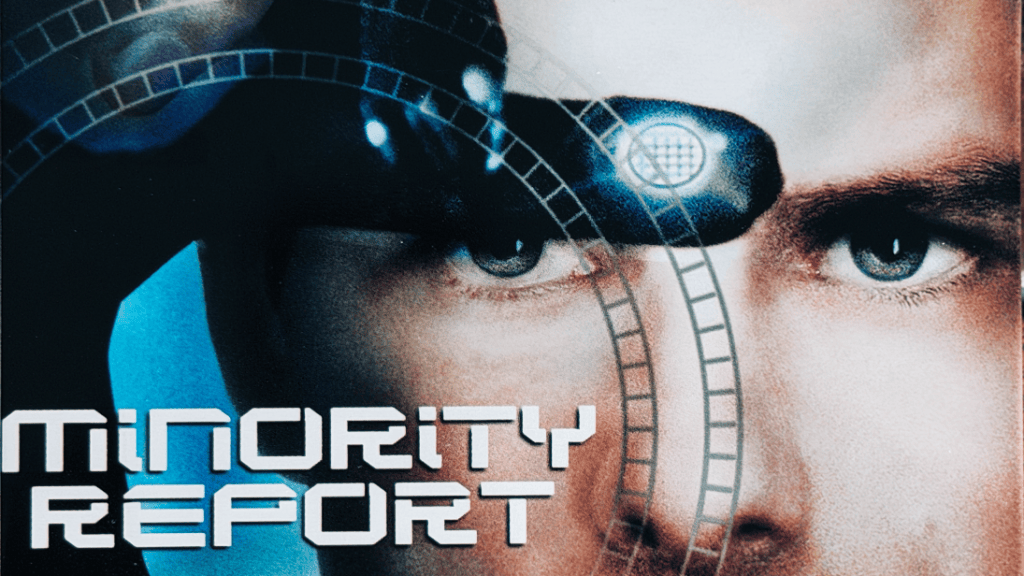
Science fiction is a great genre for bombastic social commentary. You can take a singular topic and make a whole world revolve around it. Then, because sci-fi wraps everything in a neat package, the consumers get the thought provoking insights without even realizing it. When Minority Report first came out in 2002, all I saw was a futuristic movie starring Tom Cruise being directed by Steven Spielberg. The wrapping doesn’t get much glossier than that.
Minority Report is set in the not too distant future, roughly 30 years from now. Washington, D.C. established a “pre-crime” program where murders can be detected before they occur and the alleged perpetrators can be arrested before committing the crime. Tom Cruise plays the chief of the pre-crime unit, John Anderton. He fully believes in the pre-crime system, stoutly explaining away any ethical or free-will concerns. Eventually, Anderton finds himself questioning the system, which forms the bulk of Minority Report’s plot and action.
While the pre-crime concept is heavily flawed, it is an analog for the questions surrounding surveillance and authoritarian actions we encounter in real life. With the film based on the works of Philip K. Dick, these questions have existed for decades. Current generations, our parents’ generation, and our grandparents’ generation (and arguably further back) all gave and still give up degrees of autonomy for convenience and safety. Minority Report questions where the line gets drawn for that acquiescence to stop. In the film, pre-crime depends on precognition that is “never wrong” and inevitability. The film also shows, however, that the world is too complex for simple “will they/won’t they” questions and answers. Despite the shine of its sci-fi container, Minority Report encourages questioning the status quo, sometimes heavy handedly.
A movie like this cannot be one-hundred percent philosophical with the social critiquing, and Minority Report has a lot of fun and silliness baked in to keep the ride intense but enjoyable. It is always interesting to see how media predicts the world will look in the future. Those predictions can lead to both inventive ideas and downright goofiness. Much of American society appears to look as it does today. On the streets, however, Minority Report treats us to extreme levels of monitoring, where every eye is scanned so citizens are never anonymous and corporations can customize every experience. For example, walking into the GAP, Anderton’s eyes are scanned, and he is greeted at the entrance by a personalized hologram asking how his last purchase of jeans or shorts is working out. The amount of data being collected on every individual must be staggering. It is impossible to avoid corporate intrusion into one’s life.
Beyond the Blade Runner vibes, there are cars that can travel vertically and look very I, Robot-esque. Computer screens are controlled with special gloves that allow non-contact hand movements to rearrange windows and address prompts like you would with a mouse or touchpad. Despite all these advances, data from one computer still needs to be loaded onto a drive so it can be inserted and utilized on a different device. Apparently, Bluetooth and AirDrop are just too much for the future. Then, leaning into the downright silly, pre-crime cops are equipped with jetpacks. They look ridiculous and appear too clunky to be worthwhile in any pursuit. Imagine the E.L.F.S. from The Santa Clause or Turboman from Jingle All the Way (apparently I can only pull Christmas movie references), and that is how ridiculous the cops look.
Despite the occasional quirkiness and heavy commentary, Minority Report is great fun. Tom Cruise always knows how to deliver a blockbuster, and Steven Spielberg, along with his usual collaborators (Kaminski, Kahn, Williams), brings the expected visual feast and glow. It is not just Cruise carrying the film either, with a stacked cast containing Colin Farrell, Max von Sydow, and Neal McDonough to name a few. And, if you are a Chicago Cubs fan, Pete Crow-Armstrong’s mom, Ashley Crow, is the first pre-crime non-victim we get to meet (though I recommend watching Little Big League if you want to see her featured). The world of Minority Report is full and diverse, and the cast reflects those aspects and situations with characters from silly to serious.
I had not watched MInority Report for some time, so this viewing felt nearly fresh. While I enjoyed its aesthetic and story, I definitely picked up more from the social commentary than in the past. I always watch movies primarily to have fun, but I do not mind getting prodded in the gray matter every so often to think things over and find parallels to my life. Again, when something comes wrapped in a shiny package, it can be hard to see its true meaning, and with movies that is okay. When you do see the deeper aspects, however, the whole medium becomes more than silver screens and stars.

